Toned vs. Body Recomposition After 40: How to Lose Fat, Build Lean Muscle & Change Your Body
Wanting to look 'toned' after 40 is really about body recomposition — losing fat while building lean muscle. Here's what actually works, from resistance training and protein to hormones and peptides.
By Jeremy Hicks, Co-Founder & Health Coach | Rise Wellness & Longevity | Prineville, Oregon
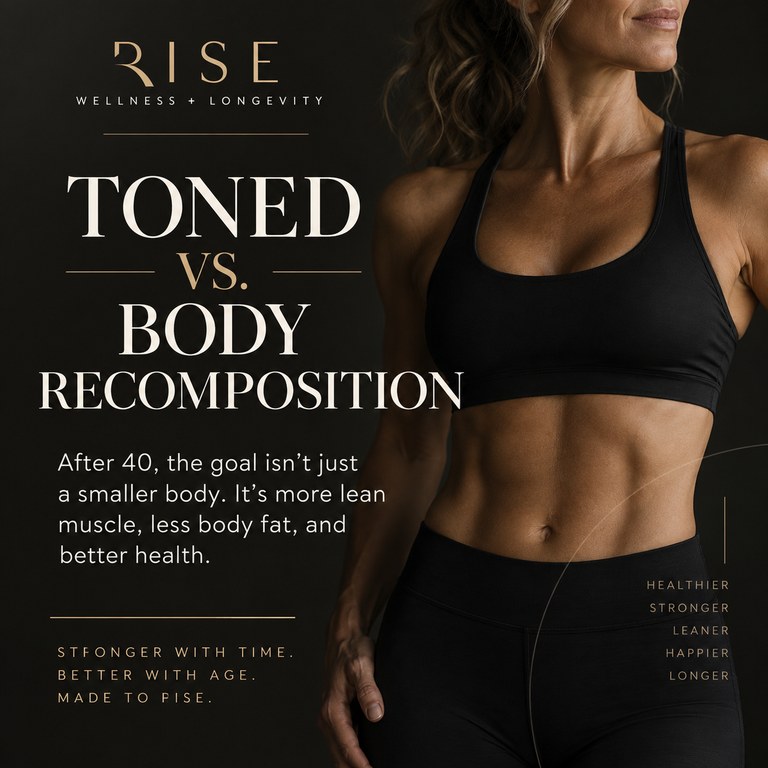
If you're over 40 and saying, "I don't necessarily want to lose a lot of weight — I just want to look more toned," what you're probably describing isn't really toning. It's body recomposition. And there is an important difference.
"Toned" is mostly a visual description. What people usually mean is that they want more visible muscle definition, less body fat and a firmer appearance. Body recomposition describes the physiological process behind that appearance: reducing body fat while maintaining or increasing lean muscle mass.
That distinction becomes increasingly important in our 40s, 50s, 60s and beyond.
At Rise Wellness & Longevity, our philosophy isn't simply about making the number on the scale smaller. We want to help people become stronger, healthier and more metabolically resilient as they age.
Stop Chasing the Scale
One of the biggest mistakes people make when trying to transform their body is allowing the scale to determine whether their program is working.
Imagine losing 10 pounds of fat while gaining 5 pounds of muscle. The scale says you lost only five pounds.
But your waist may be smaller. Your clothes may fit differently. Your muscles may be more defined. Your strength may have increased dramatically.
That is body recomposition. It's why two people can weigh exactly the same but look completely different.
Muscle and fat are different tissues. When your goal is recomposition, the question becomes less about "How much weight did I lose?" and more about "What is my body made of now compared with when I started?"
Why Body Recomposition Matters Even More After 40
As we age, maintaining muscle becomes increasingly important.
Loss of skeletal muscle with aging can eventually contribute to sarcopenia, decreased strength, reduced mobility and poorer metabolic health. Hormonal changes can also influence muscle mass and fat distribution.
This doesn't mean your best body is behind you. Quite the opposite.
Resistance training remains remarkably effective later in life.
Research in women across the lifespan found that resistance training significantly improved strength, increased functional lean mass and decreased fat mass, including among postmenopausal women. (PubMed)
A large meta-analysis involving 5,697 postmenopausal women similarly found that exercise increased muscle mass and fat-free mass while decreasing fat mass, body-fat percentage, waist circumference and visceral fat. Resistance and combined training were particularly effective for improving muscle outcomes. (PubMed)
That's one reason I would rather help someone in their 40s or 50s build muscle while losing fat than simply chase rapid weight loss.
What Actually Creates a "Toned" Body?
You don't technically tone a muscle. You build muscle and reduce enough of the fat covering that muscle for its shape and definition to become more visible.
That requires several pieces working together:
Progressive resistance training gives your body a reason to maintain and build muscle.
Adequate protein and nutrition provide the raw materials needed to repair and build that tissue.
Appropriate calorie intake can encourage fat loss without unnecessarily sacrificing lean tissue.
Recovery and sleep allow your body to adapt to training.
Hormonal and metabolic health may also deserve evaluation when symptoms or laboratory findings suggest a medical issue.
In a study of older women completing 24 weeks of resistance training, all protein-intake groups gained skeletal muscle, but women consuming moderate or higher amounts of protein experienced greater muscle gains than the low-protein group. (PubMed)
This is why body recomposition isn't a crash diet. It's a strategy.
How Long Does Body Recomposition Take?
There isn't one universal timeline.
Your starting body composition, training experience, age, sex, calorie intake, protein intake, sleep, hormones, genetics and consistency can all influence the rate of change.
Someone new to resistance training or returning after years away may respond differently than someone who has trained consistently for a decade.
The important point is that meaningful recomposition is generally measured in months, not days.
That doesn't mean you won't notice changes sooner. Strength, energy, measurements and how your clothes fit can begin changing before the scale tells the whole story.
For example, research involving older women used 24 weeks of resistance training and documented simultaneous increases in skeletal muscle and reductions in fat mass — the definition of body recomposition. (PubMed)
Can Hormone Therapy and Peptides Help With Body Recomposition?
Potentially — for appropriately selected patients — but this is where responsible medical care matters.
Medications and peptides should never replace resistance training, nutrition, adequate protein, sleep and recovery. Think of them as potential clinical tools, not shortcuts.
At Rise Wellness & Longevity, treatment decisions are made through qualified medical providers based on the individual patient's history, symptoms, laboratory results, goals, risks and appropriate medical indications.
And the scientific evidence is not equally strong for every therapy.
Testosterone Therapy for Men
Testosterone has some of the strongest body-composition evidence among hormone therapies — but that does not mean testosterone should be prescribed simply because someone wants more muscle.
In older men with clinically appropriate testosterone levels and indications, randomized trials have demonstrated increases in lean body mass and decreases in fat mass.
One 36-month randomized study of men over 65 found that testosterone treatment increased lean mass by approximately 1.9 kg while decreasing fat mass by approximately 3 kg. (PubMed)
Another trial involving older men found testosterone increased lean body mass while reducing fat mass and improving some measures of physical performance. (PubMed)
For men with obesity and hypogonadism undergoing lifestyle intervention, testosterone also helped preserve more lean mass during weight loss. (PubMed)
For the right patient, correcting medically confirmed testosterone deficiency can therefore complement nutrition and resistance training. Learn more about our testosterone replacement therapy program.
Testosterone for Women
Women need testosterone too — but female testosterone therapy is a much more nuanced subject and should not be marketed simply as a muscle-building treatment.
A randomized study in postmenopausal women who had undergone hysterectomy, with or without oophorectomy, found dose-dependent increases in lean body mass at higher testosterone exposure; however, the researchers emphasized the need for longer-term safety data. (PubMed)
In the United States, there is currently no FDA-approved testosterone product specifically for women, and broader use for body composition is not an established FDA-approved indication.
That makes individualized physician evaluation especially important. See our hormone replacement therapy for women page for how we approach it.
HCG
Human chorionic gonadotropin, or hCG, stimulates the testes to produce testosterone and may be considered in selected men, particularly when preservation of testicular function or fertility is relevant.
A randomized controlled study in older men with partial age-related androgen deficiency found that recombinant hCG increased lean body mass by approximately 2 kg and reduced fat mass by approximately 1 kg, although strength and physical activity did not significantly improve. (PubMed)
Again, the purpose is treating an appropriate hormonal situation — not simply using hCG as a weight-loss drug.
Enclomiphene
Enclomiphene is another option sometimes considered in men with secondary hypogonadism.
Rather than directly replacing testosterone, enclomiphene can stimulate the body's own hormonal signaling. Clinical trials have demonstrated increases in testosterone, LH and FSH while preserving sperm concentrations — an important distinction from conventional testosterone therapy for men concerned about fertility. (PubMed)
However, direct evidence that enclomiphene itself produces significant fat loss or muscle gain is much less established than the body-composition evidence for testosterone therapy. We shouldn't pretend otherwise.
Its potential role in a recomposition program is primarily hormonal optimization in appropriately diagnosed men, not as a stand-alone fat-loss drug.
Growth-Hormone-Releasing Peptides and Body Composition
Growth hormone and IGF-1 are involved in metabolism, tissue maintenance and body composition. GH secretion also changes with age, which has generated significant interest in therapies affecting the GH/IGF-1 pathway.
But "raises growth hormone" and "clinically proven to transform your body" are not the same claim. That distinction matters.
Tesamorelin
Among growth-hormone-releasing peptides, tesamorelin has particularly compelling human evidence for visceral-fat reduction in a specific patient population.
In a randomized placebo-controlled trial involving adults with HIV-associated abdominal fat accumulation, tesamorelin reduced visceral adipose tissue by approximately 10.9% after six months compared with 0.6% with placebo. Continued treatment produced an approximately 18% reduction at 12 months. (PubMed)
However, context is essential. FDA-approved tesamorelin (EGRIFTA WR) is specifically indicated for reducing excess abdominal fat in adults with HIV-associated lipodystrophy. The FDA label explicitly states that it is not indicated for weight-loss management. (FDA label)
Using tesamorelin for general body recomposition therefore should not be presented as an FDA-approved use.
Sermorelin
Sermorelin is an analog of growth-hormone-releasing hormone.
Research in older adults has shown that GHRH therapy can increase GH and IGF-1. Some longer-duration research has reported increases in lean body mass and reductions in body fat, particularly visceral abdominal fat. (NCBI Endotext)
The sermorelin-specific evidence is less consistent. Some studies have found increased lean mass in men while others found no significant changes in overall body composition. (PubMed Central)
So sermorelin is an interesting potential tool, but it shouldn't be marketed as a guaranteed fat-burning or muscle-building peptide.
CJC-1295
CJC-1295 is a long-acting GHRH analog.
Human randomized studies have demonstrated that CJC-1295 can significantly increase GH and IGF-1 concentrations. A study in healthy adults reported dose-dependent increases in GH and sustained elevations in IGF-1. (PubMed)
What has not been established to the same degree is that CJC-1295 produces clinically meaningful muscle gain or fat loss in otherwise healthy adults.
FDA has also identified limited clinical data and potential safety concerns regarding compounded CJC-1295. (U.S. Food and Drug Administration)
That makes medical screening and evidence-based expectations especially important.
Ipamorelin
Ipamorelin is a growth-hormone secretagogue. Human research demonstrates that it can stimulate an acute release of growth hormone. (PubMed)
But direct clinical evidence demonstrating meaningful fat loss or lean-muscle gain from ipamorelin in healthy adults remains limited.
FDA has specifically noted that available information is insufficient to establish the safety and effectiveness of compounded ipamorelin for proposed uses and has raised concerns about peptide impurities, aggregation and immunogenicity. (U.S. Food and Drug Administration)
Again: biological plausibility isn't the same thing as proven body recomposition.
MOTS-c
MOTS-c is a mitochondrial-derived peptide being studied because of its relationship with cellular energy metabolism, insulin sensitivity and metabolic signaling.
It is exciting research — but this is an area where marketing has moved considerably faster than human clinical evidence.
As of 2026, there are not yet published controlled human intervention results establishing that administered MOTS-c reduces body fat or increases muscle mass. A Phase 2 study in adults with prediabetes and overweight/obesity is underway, but results have not yet established efficacy. (Clinical Trials Registry)
FDA has also stated that it lacks adequate human exposure and safety information for compounded MOTS-c. (U.S. Food and Drug Administration)
We believe patients deserve to know the difference between promising research and proven treatment.
What About Glutathione and Lipo-Mino?
These can fit into a wellness program for entirely different reasons, but neither should be described as a proven muscle-building treatment.
Glutathione is one of the body's major antioxidant systems and is involved in cellular redox balance. Research has explored its relationship with metabolic health and oxidative stress, but current human evidence does not justify promising direct body-fat reduction or increased lean muscle from glutathione supplementation or injections. (PubMed)
Lipo-Mino/lipotropic injections, commonly formulated with combinations such as methionine, inositol, choline and B vitamins, are often promoted in weight-management programs. However, strong randomized human evidence showing that these injections independently produce meaningful fat loss is lacking.
They should therefore be viewed as potential supportive components of an individualized wellness program rather than substitutes for nutrition, exercise or evidence-based obesity treatment.
The Real Body-Recomposition Formula After 40
This is the part I want people to remember: You cannot inject your way around your habits.
A medication might help correct a hormonal deficiency. A peptide may affect a physiological pathway. A weight-loss medication may make maintaining a calorie deficit dramatically easier for an appropriate patient.
But none of those things replaces the foundation.
The foundation is still: Lift. Eat enough protein. Manage calories appropriately. Sleep. Recover. Move your body. Monitor your health. Repeat.
Then, when appropriate, medical therapies can potentially become another tool in the toolbox. That's very different from expecting the tool to build the house.
Why Rise Wellness Takes a Different Approach
At Rise Wellness & Longevity, we're interested in much more than helping you lose pounds. We want to know:
Are you losing fat?
Are you maintaining or building muscle?
Are you becoming stronger?
Are your nutrition habits improving?
Are you sleeping better?
What do your labs tell us?
How is your energy?
How is your hormonal health?
And — most importantly — are you building a lifestyle you can actually maintain?
Because being lighter isn't necessarily the same thing as being healthier.
For someone over 40, preserving muscle while reducing excess body fat may be one of the most valuable long-term changes we can pursue.
The goal isn't simply to weigh less.
The goal is to build a stronger body to carry you through the next several decades of your life.
Stronger with time. Better with age. Made to Rise.
— Jeremy Hicks, Co-Founder / Health Coach, Rise Wellness & Longevity, Prineville, Oregon
Medical therapies discussed in this article are not appropriate for everyone. Some uses described are investigational or off-label, and some compounds have limited human efficacy and safety data. Treatment should be determined by a qualified medical provider after reviewing medical history, laboratory results, potential benefits, contraindications and risks. Compounded medications are not FDA-approved and are not reviewed by FDA for safety, effectiveness or quality before marketing. (U.S. Food and Drug Administration)
Sources
- It's never too late: resistance training, strength and body composition in females across the lifespan (systematic review & meta-analysis) — PubMed
- Exercise training and body composition in postmenopausal women (5,697 participants) — PubMed
- Moderate and higher protein intakes promote superior body recomposition in older women — PubMed
- Testosterone treatment, body composition and muscle strength in men over 65 (36-month RCT) — PubMed
- Testosterone ± finasteride, physical performance and lean body mass in older men — PubMed
- Testosterone added to intensive lifestyle intervention in older men with obesity and hypogonadism — PubMed
- Testosterone dose-response in hysterectomized women: body composition and function — PubMed
- Recombinant hCG in older men with partial age-related androgen deficiency — PubMed
- Enclomiphene citrate stimulates testosterone while preventing oligospermia — PubMed
- Tesamorelin in HIV-associated abdominal fat accumulation (randomized placebo-controlled trial) — PubMed
- EGRIFTA WR (tesamorelin) FDA prescribing information — FDA Access Data
- Growth Hormone and Aging — Endotext, NCBI Bookshelf
- Growth hormone secretagogues in body composition management — PubMed Central
- CJC-1295, a long-acting GHRH analog, in healthy adults — PubMed
- Certain bulk drug substances for compounding that may present significant safety risks — FDA
- Pharmacokinetic-pharmacodynamic modeling of ipamorelin in human volunteers — PubMed
- MOTS-c Phase 2 trial in insulin resistance, prediabetes and overweight/obesity — ICH GCP Registry
- Oral glutathione supplementation and insulin sensitivity in obese males — PubMed
- Understanding the risks of compounded drugs — FDA