
Same Meal. Same Calories. Same Macros. Different Blood Sugar Response.
Meal sequencing means eating vegetables and protein before carbohydrates. Explore the research, practical steps and limits of this approach to blood sugar and metabolic health.
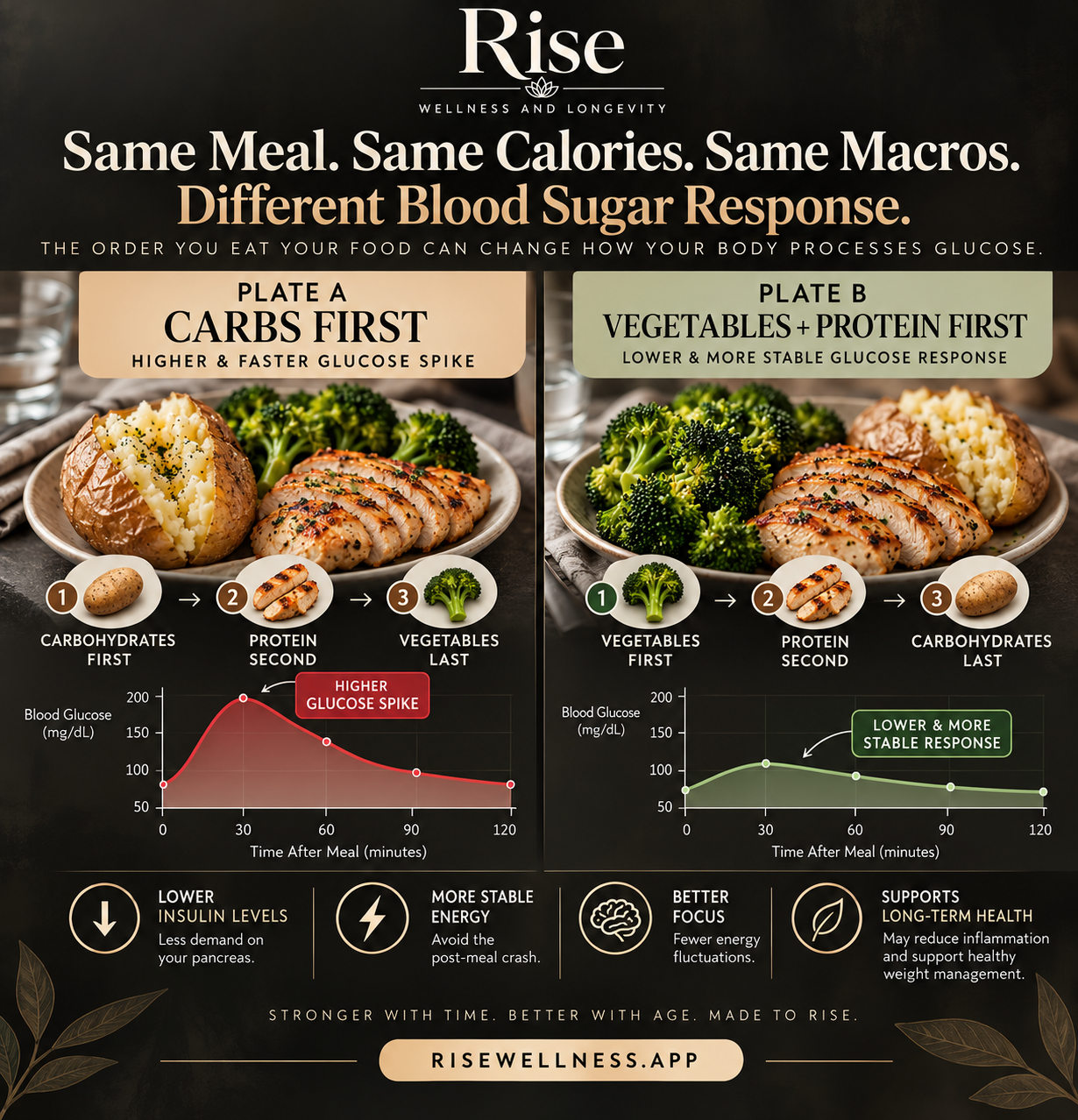
What if improving your blood sugar had less to do with WHAT you eat and more to do with the ORDER you eat it?
By Rise Wellness & Longevity Stronger with time. Better with age. Made to Rise.
Most of us have been taught that managing our weight, improving metabolic health, and maintaining healthy blood sugar levels comes down to what we eat.
Count your calories. Watch your carbohydrates. Eat more protein. Get enough fiber.
And while those things absolutely matter, emerging nutritional research reveals something fascinating:
Two people can eat the exact same meal, containing the exact same calories, carbohydrates, proteins, and fats, yet experience significantly different blood sugar responses depending on the order in which those foods are consumed.
Even more interesting? The same person can experience different glucose responses to the same meal simply by changing the order of consumption.
It's a nutritional strategy called meal sequencing, and it may be one of the simplest tools we have for supporting healthier blood sugar regulation.
And the best part?
It doesn't require expensive supplements, eliminating your favorite foods, or following another restrictive diet.
Let's look at the science.
THE SCIENCE OF MEAL SEQUENCING
Imagine sitting down to dinner.
Your plate contains grilled chicken, roasted broccoli, a baked potato, and a little olive oil.
It's a balanced meal containing protein, carbohydrates, fiber, and healthy fats.
Now imagine eating that meal in two different ways.
Scenario A: Carbohydrates First
You begin with your baked potato, followed by your chicken and vegetables.
Scenario B: Vegetables and Protein First
You begin with your broccoli, move on to your chicken, and finish with your baked potato.
Same meal.
Same calories.
Same macronutrients.
But potentially very different effects on your blood sugar.
Why?
Because the sequence in which nutrients enter your digestive system can influence how quickly carbohydrates are digested, absorbed, and delivered into your bloodstream.
And research suggests the difference can be substantial.
WHAT HAPPENS INSIDE YOUR BODY?
When we consume carbohydrates, our digestive system breaks many of them down into glucose, which enters our bloodstream.
In response, the pancreas releases insulin, a hormone that helps move glucose from the blood into cells, where it can be used for energy or stored for later.
This is a normal and essential physiological process.
However, the speed and magnitude of the glucose response can vary depending on several factors, including carbohydrate type, portion size, fiber content, and what other nutrients are consumed alongside those carbohydrates.
That's where meal sequencing comes in.
1. Fiber helps slow digestion
Eating fiber-rich vegetables before carbohydrate-dense foods may help moderate the rate at which glucose enters the bloodstream.
Certain soluble fibers form a gel-like substance during digestion, slowing nutrient movement and absorption.
Importantly, not all vegetable fibers form this gel, and fiber does not create a literal protective coating over the intestinal walls.
Instead, fiber contributes to a more gradual digestive process.
2. Protein and fat influence gastric emptying
Protein and dietary fat can slow gastric emptying, affecting how quickly food moves from the stomach into the small intestine.
Eating these nutrients before carbohydrates may help produce a more gradual glucose response.
3. Your digestive hormones respond differently
Meal sequencing can also influence hormones involved in digestion and glucose regulation, including glucagon-like peptide-1, commonly called GLP-1.
GLP-1 is a naturally occurring hormone that helps regulate blood sugar, influences insulin secretion, and contributes to appetite regulation.
Research suggests that meal order can affect these hormonal responses.
The takeaway?
Your body doesn't necessarily respond to a meal based solely on its nutritional totals.
The timing and sequence of those nutrients matter, too.
THE RESEARCH: UP TO 73% LESS POST-MEAL GLUCOSE EXPOSURE
This is where the science gets particularly interesting.
A 2015 study published in Diabetes Care examined 11 adults with type 2 diabetes.
Researchers provided participants with the same 628-calorie meal on two separate occasions.
The meal contained:
- 55 grams of protein
- 68 grams of carbohydrates
- 16 grams of fat
During one visit, participants consumed carbohydrates first.
During the other, they consumed vegetables and protein before carbohydrates.
Researchers measured blood glucose and insulin responses over the following two hours.
The results were remarkable.
When participants consumed vegetables and protein before carbohydrates:
✅ Blood glucose levels were approximately 29% lower at 30 minutes.
✅ Blood glucose levels were approximately 37% lower at 60 minutes.
✅ Total incremental glucose exposure over two hours was 73% lower.
✅ Insulin responses were also significantly reduced.
That 73% figure deserves clarification.
It represents the reduction in the incremental area under the glucose curve, a measurement of glucose exposure above baseline over time.
It does not mean everyone's blood sugar will decrease by 73%.
The study was also small and involved people with type 2 diabetes, so its results should not be assumed to apply equally to everyone.
Nevertheless, the findings demonstrated something important:
The exact same meal can produce a dramatically different metabolic response depending on the order in which it is eaten.
Shukla et al., Diabetes Care, 2015 — read the study.
WHAT ABOUT PEOPLE WITH PREDIABETES?
The potential benefits aren't limited to people already diagnosed with type 2 diabetes.
A study involving 15 adults with prediabetes compared three different eating sequences.
Researchers found that eating vegetables and protein before carbohydrates reduced peak glucose increases by more than 40% compared with eating carbohydrates first.
This suggests that meal sequencing may be a useful nutritional strategy for individuals working to improve glucose regulation before diabetes develops.
Additional research published in 2025 found that eating carbohydrates last improved certain measures of glucose control and variability in adults with type 2 diabetes, even without requiring a substantial pause between different parts of the meal.
While more research is needed to establish long-term health outcomes, these findings support a practical idea:
Small changes in eating behavior can influence metabolic health without necessarily changing the foods on your plate.
WHY BLOOD SUGAR REGULATION MATTERS BEYOND DIABETES
At Rise Wellness & Longevity, we believe metabolic health is about much more than a number on the scale.
It's about helping your body function efficiently, supporting healthy aging, and creating habits that improve your quality of life.
Healthy glucose regulation is one important piece of that picture.
⚡ More consistent energy
Large fluctuations in blood sugar can contribute to changes in how some people feel after meals.
A more gradual glucose response may help certain individuals avoid the sluggishness they experience after carbohydrate-heavy meals.
🍽️ Better appetite awareness
Blood glucose regulation, digestive hormones, and appetite are closely connected.
Protein and fiber can also support feelings of fullness, making balanced meals an important part of sustainable nutrition.
❤️ Supporting long-term metabolic health
Chronically elevated blood glucose is associated with metabolic and cardiovascular complications, particularly in people with diabetes.
Improving glucose management is an important component of reducing these risks.
⚖️ Supporting healthy weight management
Meal sequencing isn't a magic weight-loss solution.
However, when combined with adequate protein, sufficient fiber, resistance training, physical activity, and appropriate calorie intake, it may complement a comprehensive weight-management strategy.
The goal isn't to eliminate every blood sugar increase.
Blood sugar naturally rises after eating. That's normal.
The goal is to support your body's ability to regulate glucose effectively.
HOW TO PRACTICE MEAL SEQUENCING
You don't need a complicated nutrition plan to experiment with this approach.
At your next meal, try following this simple order:
STEP 1: START WITH FIBER-RICH VEGETABLES
Begin with foods such as broccoli, asparagus, spinach, green beans, Brussels sprouts, or a leafy green salad.
These provide valuable fiber, vitamins, minerals, and other nutrients.
STEP 2: EAT YOUR PROTEIN AND HEALTHY FATS
Move on to your chicken, fish, lean beef, tofu, eggs, or another protein source.
Include healthy fats as appropriate for your nutritional needs.
Protein is especially important for maintaining muscle mass, supporting recovery, and promoting satiety.
STEP 3: FINISH WITH YOUR CARBOHYDRATES
Enjoy your potatoes, rice, pasta, bread, or other carbohydrate-rich foods toward the end of the meal.
You don't necessarily have to eliminate these foods.
Simply changing when you eat them may help moderate your glucose response.
And you don't need to wait 10 or 15 minutes between every food group to get started.
Research suggests that eating carbohydrates last, even during a normal meal, may offer benefits.
THE BIGGER PICTURE: METABOLIC HEALTH IS MORE THAN CALORIES
One of the biggest misconceptions about nutrition is that every aspect of health can be reduced to calories consumed versus calories burned.
Energy balance is fundamental to weight management.
But our metabolic health is influenced by much more than calorie totals.
Meal composition, food quality, physical activity, sleep, stress, body composition, and individual physiology all play important roles.
And as meal-sequencing research demonstrates, even the order in which we consume nutrients can influence our immediate glucose and insulin responses.
This doesn't mean calories no longer matter.
It means good nutrition is about understanding how the body responds to food, not simply counting what's on the plate.
At Rise Wellness & Longevity, this is exactly why we emphasize education, sustainable habits, and individualized support.
We want our clients to understand their bodies, not simply follow another list of foods they're told they can or cannot eat.
THE RISE DIFFERENCE: SMALL CHANGES. MEANINGFUL PROGRESS.
You don't have to completely overhaul your diet overnight to begin improving your health.
Sometimes meaningful progress starts with something as simple as eating your vegetables first.
At Rise Wellness & Longevity, our approach focuses on the bigger picture:
🥗 Nutrition education that helps you understand how food affects your body.
💪 Muscle preservation and body composition because healthy aging is about more than losing weight.
🧬 Metabolic health and laboratory testing to better understand your individual health needs.
⚖️ Medical weight-management options, when clinically appropriate.
❤️ One-on-one health coaching to help turn knowledge into sustainable daily habits.
We're not interested in quick fixes.
We're interested in helping people build healthier, stronger lives through practical, evidence-informed strategies.
Because improving your health doesn't always require doing more.
Sometimes it simply requires doing things differently.
YOUR NEXT MEAL IS AN OPPORTUNITY
Here's my challenge to you:
At your next meal, don't change what you're eating.
Just change the order.
Start with your vegetables.
Follow with your protein.
Finish with your carbohydrates.
It's a small adjustment that may make a measurable difference in how your body processes that meal.
And remember, no single nutritional strategy works identically for everyone. If you have diabetes, particularly if you take insulin or medications that can cause low blood sugar, discuss dietary changes with your healthcare professional.
You don't have to be perfect to make progress. You just have to be willing to start.
READY TO TAKE YOUR METABOLIC HEALTH TO THE NEXT LEVEL?
At Rise Wellness & Longevity, we're here to help you understand your health, improve your habits, and build a stronger foundation for the years ahead.
Whether your goals include weight management, improving your nutrition, supporting healthy aging, or simply feeling better in your own body, we're here to help.
Schedule your FREE health coaching consultation today.
RISE WELLNESS & LONGEVITY
Stronger with time. Better with age. Made to Rise.
For personalized support in Prineville, Crook County and Central Oregon, explore our health and nutrition coaching, medical weight-loss care, and clinician-guided GLP-1 programs. Meal sequencing is a nutrition strategy, not a substitute for prescribed GLP-1 medication or diabetes treatment.
Sources
- Shukla et al. (2015) — Food Order Has a Significant Impact on Postprandial Glucose and Insulin Levels — https://doi.org/10.2337/dc15-0429
- Shukla et al. (2017) — Carbohydrate-last meal pattern lowers postprandial glucose and insulin excursions in type 2 diabetes — https://doi.org/10.1136/bmjdrc-2017-000440
- Shukla et al. (2019) — The impact of food order on postprandial glycaemic excursions in prediabetes — https://doi.org/10.1111/dom.13503
- Touhamy et al. (2025) — Carbohydrates-Last Food Order Improves Time in Range and Reduces Glycemic Variability — https://doi.org/10.2337/dc24-1956
Educational disclaimer: This article is intended for general wellness education and does not replace individualized medical advice, diagnosis, or treatment. Meal sequencing may complement, but should not replace, prescribed diabetes management.
The Rise Journal
Never miss an article
Practical guidance on medical weight loss, GLP-1s, hormones, peptides and healthy aging — delivered to your inbox. No spam, unsubscribe anytime.